
Safe kitchen appliances for seniors with dementia
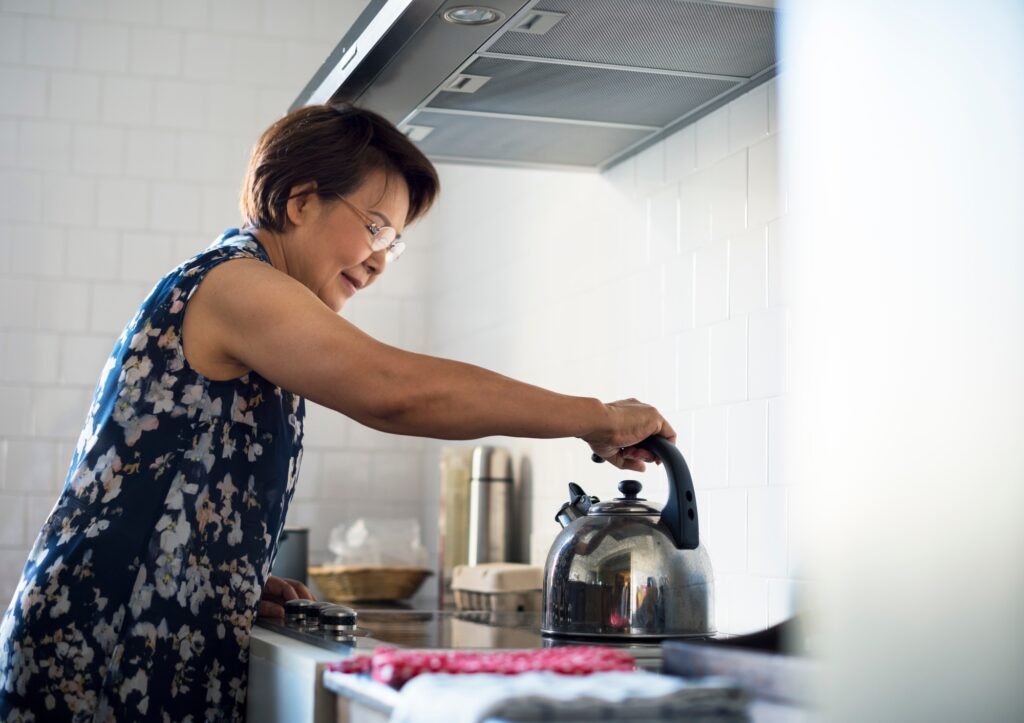
A dementia-safe kitchen runs on one principle: every appliance must be safe when someone walks away mid-task — because they will. That means auto shut-off everywhere, dials instead of button panels, and no open flames or hot plates. Below is the room-by-room version, appliance by appliance.
When someone you love starts having trouble in the kitchen, the advice you’ll hear most is “just take over the cooking.” Sometimes that day comes. But taking the kitchen away early costs independence, dignity, and often appetite — people eat less when they stop participating in meals. The better first move is changing what’s in the kitchen so that ordinary moments of forgetfulness stop being dangerous.
Three rules guide every recommendation below. One: the appliance must shut itself off — walking away mid-task isn’t a possibility with dementia, it’s a certainty. Two: dials beat buttons — a rotary dial is the control scheme someone’s hands have known for sixty years, and muscle memory outlasts short-term memory. Three: change the appliance, keep the routine — the goal is the same morning coffee and the same lunchtime soup, made safe.
The Safe Kitchen at a Glance
| Appliance | Why It's Safer | Our Pick | |
|---|---|---|---|
| Microwave | Mechanical dial — timer runs out, it stops. No buttons to misread. | Commercial Chef Rotary Dial | Price |
| Electric Kettle | Shuts off at boil; won't scorch if run dry. Retires the stovetop kettle. | Cosori 1.7L Auto Shut-Off | Price |
| Coffee Maker | One button, no carafe pour, auto-off minutes after brewing. | Keurig K-Express | Price |
| Toaster | Pops up and shuts off by design, every cycle. | Full toaster guide → | |
| Grill | Electric only — no gas, no flame, controllable at the outlet. | Full grill guide → | |
#ad — product links above are Amazon affiliate links.
1. The Best Microwave for Seniors with Dementia: Go Back to the Dial
Here’s the counterintuitive truth about dementia-friendly microwaves: the best one looks like it’s from 1985. Modern microwaves are a wall of buttons, presets, and multi-step sequences — exactly the kind of interface that turns “heat up soup” into a frustrating puzzle. What you want is a mechanical dial: twist to two minutes, it counts down, it dings, it stops. The timer is the off switch, the same way it was on the microwave they used for decades.
The Commercial Chef Rotary Dial Microwave is the cleanest version of this still on the market: two dials (power level and time), a pull handle instead of a push-button door release — easier for arthritic hands — and a 900-watt, 0.9 cubic foot size that handles a dinner plate. There is nothing to program, nothing to misread, and no way to accidentally set it for 20 minutes by mashing digits.
Two microwave habits worth pairing with it: keep a stack of microwave-safe bowls in one obvious cabinet (metal in the microwave is the most common dementia-microwave accident), and tape a small card to the door — “no foil, no metal, bowls from this shelf.”
2. Electric Kettle: Retire the Stovetop Whistler
The stovetop kettle is one of the most dangerous items in an aging kitchen — it depends entirely on someone hearing the whistle, coming back, and turning off a burner. An electric kettle deletes all three requirements. The Cosori 1.7L shuts itself off when the water boils and has boil-dry protection, so even switched on empty it just turns off instead of scorching. Tea, instant oatmeal, soup cups — the whole hot-water routine keeps running, minus the burner.
3. Coffee Maker: One Button, No Hot Plate
The hazard in a classic coffee maker isn’t the brewing — it’s the hot plate that stays on for hours afterward, and the heavy glass carafe of scalding coffee that has to be poured by an unsteady hand. The fix is either a one-button single-serve like the Keurig K-Express (auto-off five minutes after brewing, no carafe at all) or a thermal-carafe machine that shuts off after brewing and keeps coffee hot in an insulated bottle instead of on a burner.
We compare single-serve against thermal carafe in detail — including which suits which drinker — in our full guide to the best coffee makers for seniors aging in place.
4. Toaster: The Appliance That Got It Right First
The humble pop-up toaster is quietly the model for this entire list — it shuts off by mechanical design at the end of every cycle, no memory required. What matters is choosing one with truly simple controls, and being careful with toaster ovens, many of which have a “Stay On” mode that defeats the timer entirely. Our full breakdown of the safest toasters for Alzheimer’s and dementia patients covers three picks, the toaster-oven warning, and the caregiver tricks that make any toaster safer.
5. The Stove: The Honest Conversation
No product on this page matters more than getting the stove right, and no appliance is harder to replace — so here’s the staged approach caregivers actually use:
- Early stage: supervised cooking continues; add stove knob covers (the childproofing kind) or simply pull the knobs off between meals and keep them in a drawer — most gas and electric ranges keep working normally with knobs re-attached in seconds by a caregiver.
- Middle stage: shift stovetop tasks to the safer stand-ins on this page — microwave, kettle, and a countertop induction burner for supervised cooking together: the coil only heats compatible pans, shuts off when the pan is removed, and the surface never holds an open flame.
- Later stages: for gas ranges, the cleanest solution is having the shutoff valve behind the range closed (or a plug pulled, for electric) so the stove only operates when a caregiver enables it. An automatic stove shut-off device with a motion timer is the middle ground if cooking independence still matters.
The theme: disable capability quietly rather than announcing prohibition. “The stove’s broken, let’s use the microwave” preserves dignity in a way “you’re not allowed to cook anymore” never will.
6. Slow Cooker: The Sleeper Pick
A slow cooker is accidentally one of the most dementia-compatible appliances made: a caregiver loads it in the morning, it cooks at a low temperature all day with nothing to monitor, and a hot meal is ready at dinner with zero midday kitchen tasks. If you buy one for this purpose, choose a model with a programmable timer that switches to warm automatically — and treat it as caregiver-operated equipment, not something the person runs alone.
7. The Grill: Electric or Nothing
Outdoor cooking deserves its own conversation — gas grills are the single riskiest appliance many households own once memory loss enters the picture. The short version: go electric, control it at the outlet with a timer, and keep the ritual alive. The long version, including three picks and the $15 accessory that gives any electric grill guaranteed shut-off, is in our guide to safe grills for seniors with dementia.
Beyond Appliances: The Hands Matter Too
Half of kitchen safety isn’t the appliance — it’s whether hands can grip the jar, steady the fork, and hold the knife. Our companion guide to adaptive kitchen tools for seniors covers the six aids we’d buy first: jar openers, foam grips that make familiar utensils easier to hold, weighted utensils for tremors, and more.
One with a mechanical rotary dial instead of a digital button panel. The dial is the timer and the off switch in one — twist, it counts down, it stops — and it matches the microwaves most seniors used for decades, so muscle memory does the work. Avoid models with push-button door releases (hard on arthritic hands) and large multi-preset panels.
Often yes, well into the disease — if the appliances are chosen for it. The requirements are auto shut-off on everything, familiar simple controls, and a caregiver who adjusts what's available as the condition progresses. Supervised trial runs tell you more than any product page.
In stages: knob covers or removed knobs early on, a shift toward microwave/kettle/induction cooking in the middle stages, and a closed gas valve or unplugged range later, so the stove only works when a caregiver enables it. Automatic stove shut-off devices are the middle ground when independent cooking still matters.
Not as a first move. Cooking and kitchen routines are tied to identity, appetite, and independence — removing them early often costs more than it protects. Replace risky appliances with safer equivalents, simplify what remains, and remove things only when supervised use is no longer safe.
Automatic shut-off. Every appliance in a dementia household must be safe when the person walks away mid-task — not if, when. Simple controls and cool-touch surfaces reduce frustration and burns; auto shut-off is what prevents fires.
Free Delivery on Everything You Order
As a caregiver you're ordering constantly. Prime pays for itself fast — free delivery, same-day on many items, and Prime Video included.
Try Prime FreeThe Care Pack Store
Every product in our Amazon store is something a caregiver in our community has actually used and recommends — from daily-living aids to comfort items.

Cory Clark
Cory Clark is the founder of Care Pack Club and a firsthand caregiver with experience supporting both aging grandparents and parents through the challenges of elder care. After spending years navigating assisted living transitions, cognitive decline, and the emotional weight that comes with caring for the people who once cared for you, Cory created this site to share what he learned. Every article reflects a real situation, a real question, or a real decision that families face. Care Pack Club exists because Cory couldn't always find the answers he needed, and decided to document them for the next family that goes looking.
Keep reading

Movies and Alzheimer’s: Why an Old Favorite Can Reach Someone Words Can’t
As an Amazon Associate, Care Pack Club earns from qualifying purchases. If you buy through our links, we may earn a small…

Signs Your Parent May Need Memory Care
Watching a parent struggle with memory loss is one of the most difficult experiences a family caregiver can face. You may notice…